▢ Case study · 2026
Syncro
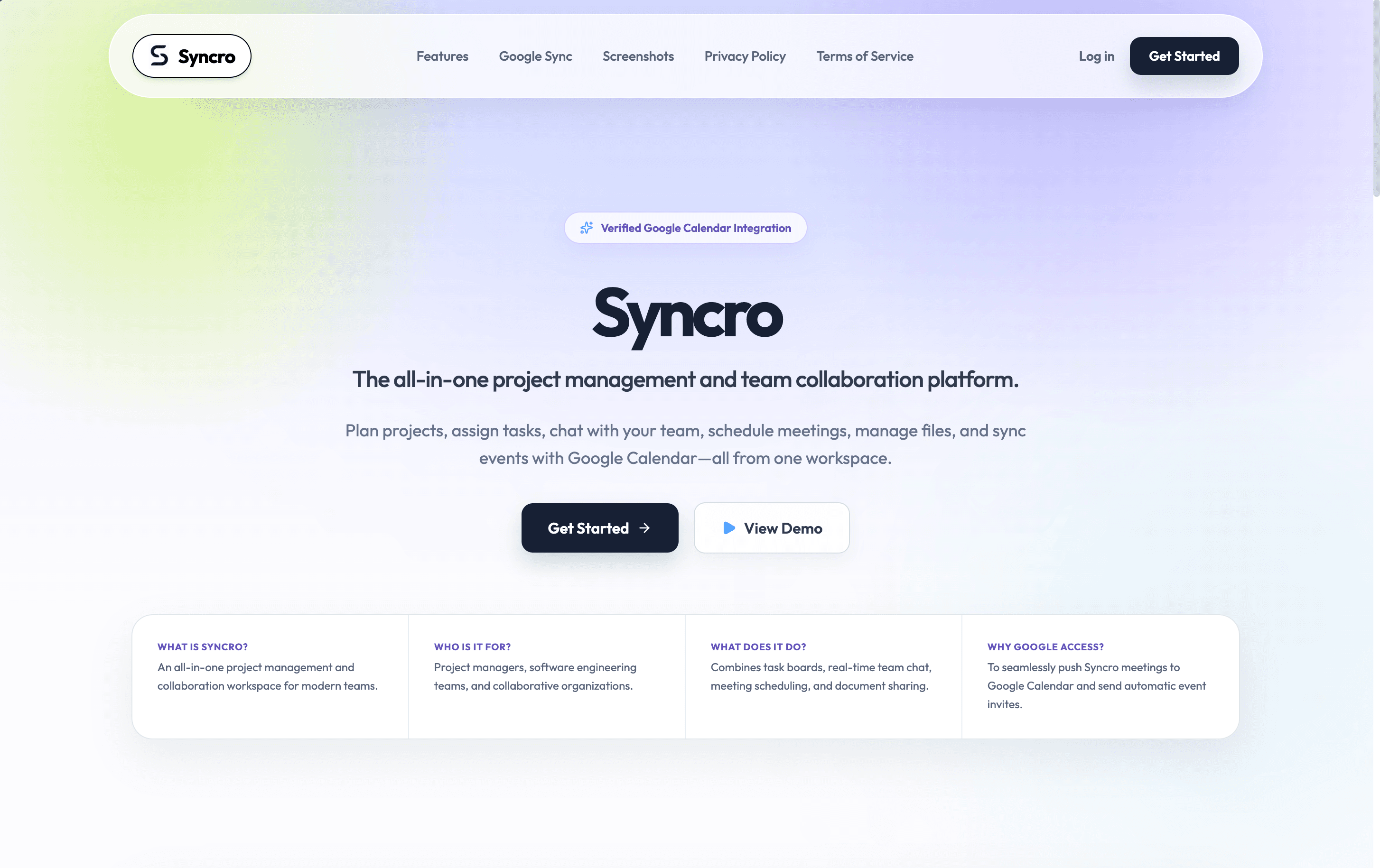
A team collaboration workspace with real-time whiteboards, Slack-style chat, Kanban and Gantt task boards, and Agile sprint planning. Each workspace’s data is isolated, and sensitive fields are encrypted at rest.
- Role
- Solo full-stack developer
- Year
- 2026
- Timeline
- Jul to Sep 2026
- Built with
- React 19ViteTailwind CSSRedux ToolkitNode.jsExpress 5Socket.IOPostgreSQLPrismaRedisInngestWeb Crypto APIVitestPlaywrightVercel
01
The problem
Engineering teams spread their work across too many tools: Slack for chat, Miro for whiteboards, Jira for sprints, and something else for timelines. Context gets lost every time someone switches apps, and each tool has its own permissions and bill.
I wanted one workspace where a team can sketch a system design, turn it into tasks, plan a sprint, and discuss it, all updating live for everyone. Each organization’s data had to stay strictly separate.
02
What he built
Syncro is a multi-tenant team workspace with five main areas.
Live whiteboards
A vector drawing canvas with sticky notes, connecting arrows and links to tasks
Live cursors for every member, broadcast over Socket.IO (opens in a new tab)
One-click SVG export
Messaging
Public and private channels, and direct messages
Threaded replies, pinned messages and starred channels
Tasks and projects
A drag-and-drop Kanban board that updates instantly for everyone
A Gantt timeline for tasks, assignees and milestones
Task dependencies, with checks that block circular ones
Agile workflows
Sprint and epic planning with capacity tracking
Live retrospective boards with upvoting
Sub-teams and a role matrix (Owner, Admin, Manager and Member)
Security
Email-based two-factor authentication
Field-level encryption for chat messages, task comments and 2FA credentials
A tamper-evident audit trail
Architecture. The React 19 frontend is on Vercel. The Express 5 backend uses Socket.IO (opens in a new tab) for real-time updates, Neon Postgres with Prisma, Upstash Redis for caching and rate limiting, and Inngest for background jobs. The backend follows a clean hexagonal architecture, and a test checks that its layer boundaries are respected.
03
The hard parts
Keeping workspaces apart. In a multi-tenant app, one missed filter can show one company’s data to another. Syncro enforces isolation at the database level with Postgres row-level security, and a dedicated test suite checks that no workspace can read another’s data.
Encryption without touching every query. I wanted sensitive fields encrypted before they reach disk, without adding encryption code to every query. So I used Prisma Client extensions ($extends), which encrypt and decrypt fields automatically on every read and write.
Real-time without chaos. Whiteboards, chat, Kanban and retro boards all sync live over Socket.IO (opens in a new tab). Slower work like notifications, recurring tasks and sprint updates is handed off to Inngest background jobs, so real-time events stay fast.
Speed. I applied several layers of optimization:
Route-level code splitting, so each page (chat, calendar, whiteboards) loads only when it’s opened
Stale-while-revalidate caching, so screens show cached data instantly while refreshing in the background
Deduplication of identical in-flight requests
Redis caching for workspace lists, role checks and notification feeds
Composite indexes on common database queries
Finding a real bug instead of blaming flakiness. One test suite failed locally but passed in CI, and I first put it down to cache timing. It turned out to be a real bug. Upstash’s Redis client turns stored 'true' and 'false' strings back into booleans, so two permission checks comparing strings silently broke against the real service. CI used an in-memory fallback, which is why it never showed up there. I fixed the checks and documented the mistake.
Security audit. I ran an internal security audit and documented what it found and fixed. One fix removed a hardcoded 2FA bypass code that would have been a risk if production were ever misconfigured.
04
How it turned out
Syncro is live at syncro.piyushydv.com (opens in a new tab), with a separate API at api.syncro.piyushydv.com (opens in a new tab).